
Private Keys in a Nutshell
5 min read – Oct 04, 2022
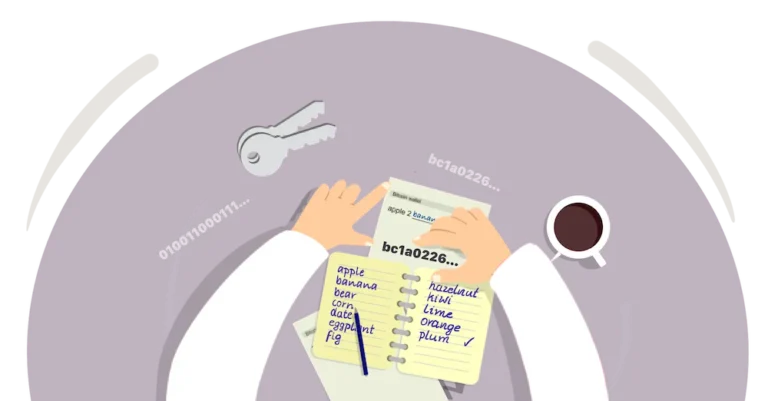
The blockchain has many equally important components; without them, the puzzle wouldn’t be complete. One of them is a Private Key.
Everyone who enters the cryptocurrency space should know the private key’s role and understand how it works.
A Private Key never comes alone and is always created along with a Public Key. The Private Key should always be taken care of with the highest privacy and never shared with others. It constitutes ownership, and losing it, is equivalent to losing the assets. Recreating the private keys is technologically impossible; therefore, good care of them should be your priority.
A Public Key allows receiving the crypto funds (the public addresses derive from it); a Private Key allows sending the funds.
Mnemonic Phrase
Note: We use the term Mnemonic Phrase in this article; however, many other names are in circulation. Some of the common are “Mnemonic Seed”, “Seed Phrase”, “Seed”, “Recovery Words”, or “Recovery Keys” and many more.
When you set up the wallet, most likely, you will receive something called a Mnemonic Phrase.
A Mnemonic Phrase is a set of 12 to 24 words that acts as a representation of the data used to recreate your wallet keys.* Before mnemonic phrases were introduced (with the BIP39 proposal — BIP stands for Bitcoin Improvement Proposals), private keys for the wallets weren’t so friendly to the end user. Usually, they were provided as long, random alphanumeric characters, hard to remember, and easy to make a very costly error.Before mnemonic phrases were introduced (with the BIP39 proposal — BIP stands for Bitcoin Improvement Proposals), private keys for the wallets weren’t so friendly to the end user. Usually, they were provided as long, random alphanumeric characters, hard to remember, and easy to make a very costly error.
These words are not just any words taken from the English dictionary; these are 2048 exclusively selected that meet specific criteria.
The full list of words you can find here.
For more in detail information about BIP-39 and Mnemonic Phrase proposal, you can find it here
*technically, it is a human-readable representation of entropy used to generate a master seed, which then recreates your Private and Public Keys — but for everyday use, thinking of it as your key works.
Why is there a difference in the number of words?
The two most common entropy sizes used for mnemonic phrases are 128 and 256 bits. The 256-bit version is considered more secure. At the time of writing, most wallets still operate with 128 bits. 256-bit entropy is typically represented by 24 words, while 128-bit entropy is represented by 12 words.
Most of the time Private key will be generated for you by the wallet of your choice as a Mnemonic Phrase. You can, however, create the key by yourself. The process of creating the key requires some technical knowledge. You can find many online tutorials about this topic, so we will not cover the details here.
If you want to generate a private key by yourself, you can try by following this article